
My Warsh decoder ring
Warsh hasn't given up on the idea that productivity, not the Fed, will solve the inflation problem.

History shows that when the Fed’s message is more opaque investors simply dig deeper for nuggets of information. Here is a guide to how to sort through the subtle signals from Kevin Warsh.
Back to early Greenspan
Through the first half of Greenspan’s term, the Fed was still using the old communications model for central banks. Rather than give clear answers to questions and guidance on the economy and policy, central banks practiced “constructive ambiguity.” The result was a game where Greenspan tried to avoid saying anything interesting, causing Fed Watchers to look even harder for clues. The classic example was when Greenspan asked if the stock market may be experiencing “irrational exuberance” and Fed watchers immediately concluded that this was a statement not a question, and the stock market dropped.
In my book “Ben Bernanke’s Fed” I lamented that my “Greenspan decoder ring” was no longer useful because the new Fed chair brought transparency to the Fed. Indeed, in writing that book I was aided by the fact that as a Governor Bernanke gave detailed speeches on almost all the important questions around monetary policy. These speeches went well beyond sound bites: he laid his cards on the table and offered a rich literature review in support of his views. On the job, Bernanke brought the Fed in line with other central banks that already were highly transparent and offered a lot of forward guidance on the policy path.
Warsh’s dramatic pullback on communication does not mean he is no longer giving signals, rather it is making the much harder to decipher. Here is some. basic guidance and some early results from my decoder ring.
Designing a decoder ring
There are several basic principles in this exercise. First, because the signals tend to be vague it is very important to avoid confirmation bias—a tendency to find what you want to find. Second, it is important to understand the context of the comments, including how they fit in with his older views. Third, what Warsh doesn’t say can be as important as he does say. Avoiding some questions and answering others can give clues to his thinking.
With that said here are some important examples from the post-FOMC press conference, his comments at Sintra and from the people he chose for his taskforces.
The leader doth protest too much
Warsh has found many ways to pledge allegiance to the Fed’s 2% target. Varying the way to express it allows him to say it more often and puts an exclamation point on it. In the latest example, at Sintra, he said that anyone expecting the Fed would tolerate inflation running above its 2% goal “would be disappointed.”
Putting on my decoder ring my first thought was: who are these people and why do they believe the Fed isn’t focused on hitting its target? I don’t think observers are worried about the 17 FOMC members forecasting flat or rising rates. Indeed, they are likely encouraged by the rightward shift in forecasts for the year-end funds rate at the June meeting (chart).
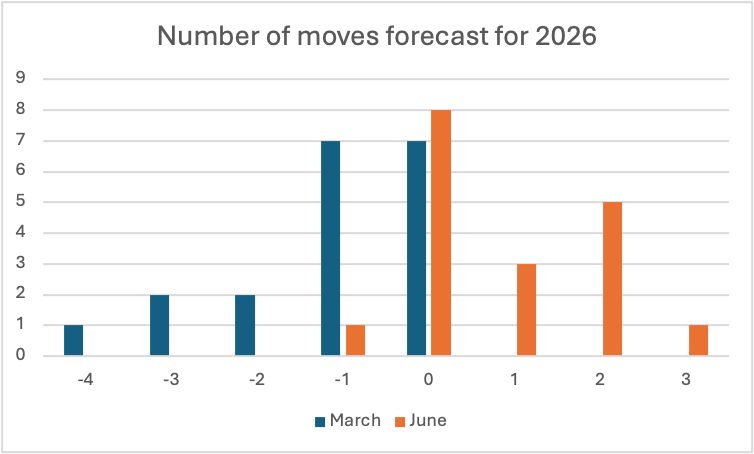
Source: Federal Reserve Board and author’s estimates
Here it is important to understand the context. Warsh comes to the Fed with two credibility challenges. First, Trump promised that he would only nominate a Fed chair who shared his views. Second, in his campaign for the job Warsh embraced the idea that a surge in productivity growth would bring down inflation so the Fed should be cutting rates.
Warsh has two ways to try to allay those concerns: (1) start to distance himself from that dovish narrative, or (2) buy time by emphatically restating what he will hit the target. He seems to have chosen the later.
Will AI rescue us?
As I noted above, during his campaign for the chair, he argued that surging productivity would solve the remaining inflation problem and allow the Fed to cut rates. According to my decoder ring, now that he is no longer giving forward guidance his strategy is to repeatedly talk about the benefits of high productivity growth. His closing sentence at the press conference was: “If I heard one other thing around that subject over the course of the last couple of days, what I heard was that strong productivity-led growth is not something that we fear, but something we embrace.”
What is striking about this sentence is that he feels compelled to affirm what everyone on the FOMC has always believed. This is Econ 101: productivity-led growth is disinflationary, not inflationary. Hence while he is no longer explicitly making the case for rate cuts, it sure looks like he is not ready to abandon the logic for cuts.
Hiring a choir
His decision to form a task force on productivity and jobs, and staff it with true believers, is another strong sign of his dovish views on how to hit the inflation target. Marc Andreesen, Asha Sharma and Charles I. Jones are on the same page as Warsh. All agree that AI-driven productivity gains will let the economy grow faster without stoking inflation, opening the door to rate cuts. There is no need for this group to meet since we already know their conclusion.
Focus on the future
A final example of Warsh’s revealed preference is how he dodges questions about the near-term inflationary impact of the AI buildout. As many FOMC members point out, it is clearly impacting inflation and the pressure could last a long time. Asked about it at Sintra, Warsh said, “I’m not going to make a judgment now.” This is a pressing question for the Fed, helping drive near-term policy, and yet Warsh hasn’t formed a judgment?
Where’s Warsh?
It is early days, but I’m relatively confident in my Warsh decoder ring. Most important, it suggests that Warsh has not given up on the idea that productivity growth will rescue us from inflation. It should come in handy for Warsh’s testimony to the House Financial Services Committee tomorrow at 10:00 am.